
Mills County Court Records After Arrest
The arrest-to-court path in Mills County has more than one record keeper. The Mills County Sheriff's Office creates the jail-side booking record when a person is taken into custody. After that, a prosecutor decides what charge to file, and the clerk keeps the court pleadings and papers that become the case record. For felony matters, the local research points to the 35th District Court and the Mills County District Clerk. The District Clerk page says that office is custodian of pleadings and papers in civil and criminal cases for courts served by the clerk, including the 35th District Court.
The first question is not just whether someone was arrested. It is whether a case has been filed, where it was filed, and what status each charge has now. A roster line can be useful for custody and booking facts, while Mills County jail inmate records help with current custody and release checks. Booking photos are a different issue, and the Mills County jail mugshots page covers the booking-photo request route. Court records after a Mills County jail arrest focus on the filed case: complaint, information, indictment, bond order, warrant setting, disposition, judgment, or dismissal.
Record path: Arrest and booking create a jail record. A filed charge creates a court record. Final guilt or dismissal appears in the court case, not in the booking event alone.
Mills County Tyler Court Records
The county provides public online access through Mills County Clerk Self-Service. The Tyler portal disclaimer says the County Clerk provides the site as a public service, that the index is similar to a library card catalog, and that users should search all spelling variations and other criteria. That wording matters. The portal can help locate a case, but the index is not the same as a certified copy of a court record. For court records after a jail arrest, use the online index to find possible case entries, then confirm the exact filed charge, court, and status with the clerk if the result will be used for a formal purpose.
The Mills County Clerk Self-Service entry page is the subject-matched public court search screenshot for this page.
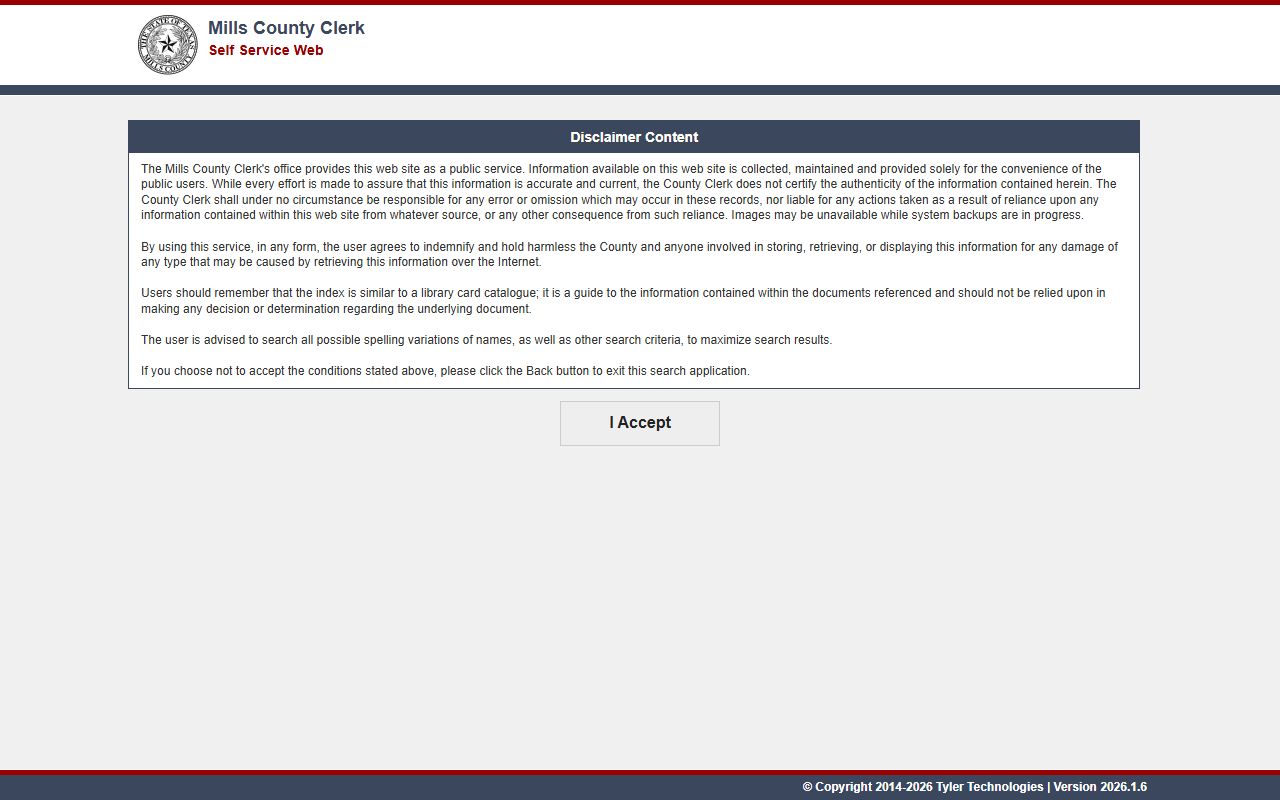
The portal image reinforces the main search limit: a court index is a starting point, so name spelling, case number, and court level still need careful review.
| Search point | How to use it | Limit to remember |
|---|---|---|
| I Accept | Accept the disclaimer before entering the portal. | The disclaimer controls use of the public index. |
| Name variations | Search all likely spellings, initials, and name order changes. | A missed spelling can hide a real case. |
| Case or document index | Use visible case numbers or document references to narrow results. | The index is not a certified court copy. |
| Clerk confirmation | Ask the clerk about copies, certification, and file status when needed. | Online data may not show every filing or restriction. |
District Clerk Court Records
For felony charges and district-court criminal pleadings, the Mills County District Clerk is the key local office. The official District Clerk page identifies the 35th District Court and Presiding Judge Mike Smith. State judicial personnel materials list Judge Mike L. Smith for the 35th District Court and District Attorney Micheal Murray for the district attorney's office in Brownwood. The Mills County directory research also lists the District Clerk's Office phone as (325) 648-2711 and the District Attorney's Office phone as (325) 646-0444.
The official Mills County District Clerk page is shown below because it is the local source for district-court record custody.
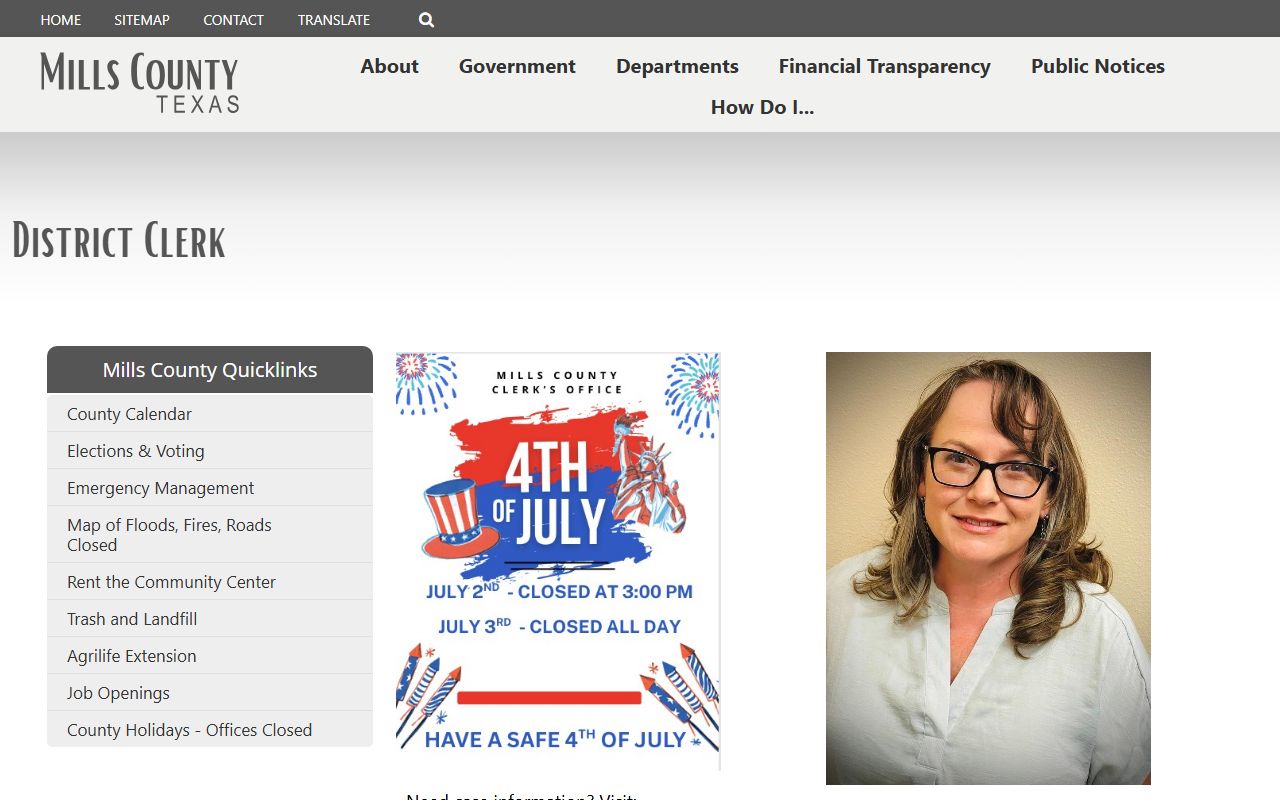
Use the District Clerk contact path when a felony court record after arrest is not clear from the public index or when certified copies are needed.
35th District Court and Prosecutor Contacts
Mills County District Clerk
Courthouse records for district-court criminal pleadings
Phone: (325) 648-2711
Fax: (325) 648-3251
35th District Attorney Micheal Murray
200 S Broadway
Brownwood, TX 76801-3192
Phone: (325) 646-0444
Find Court Records After Arrest
A careful Mills County court records after arrest search starts with the jail facts and then moves to the court file. The booking charge can tell you why the person entered jail, but it is not the last word. A prosecutor may file a different charge, decline a charge, add a charge, reduce an offense level, or present a felony case to a grand jury. Court records are the place to look for the filed charge, case number, hearing settings, motions, bond orders, disposition, and final judgment.
- Confirm the booking through the Mills County jail roster or by calling the sheriff's office if the roster is not clear.
- Write down the exact name spelling, arrest or booking date, visible charge wording, and any case or warrant number.
- Search Mills County Clerk Self-Service, using spelling variations and any case number found in jail or court paperwork.
- Check the District Clerk route for felony and 35th District Court matters, because those pleadings are kept by the district clerk.
- For lower-level citations, use the county's official GovRec citation-payment link only as a payment or citation clue, not as a full criminal-history search.
- Ask the clerk for certified copies if the result must prove a charge, disposition, or judgment.
Mills County Charging Documents
The charge record begins when the accusation is placed into court form. In Texas, that can happen through a complaint, an information, or an indictment, depending on the offense and court level. These terms are easy to mix up with the jail roster charge, but they are not the same thing. A roster charge is part of the custody record. A charging document is part of the court case after the arrest.
| Document | Who uses it | What it means after arrest |
|---|---|---|
| Complaint | Law enforcement or prosecutor | A sworn accusation that can support a criminal case or warrant process. |
| Information | Prosecutor | A prosecutor-filed charging paper used in many Texas criminal cases. |
| Indictment | Grand jury | A grand-jury charging instrument, most often tied to felony prosecution. |
District Attorney Micheal Murray's office makes filing decisions for 35th Judicial District felony matters serving Mills County. The prosecutor's role is separate from the sheriff's booking role. That is why a person can appear in the jail record before the final filed charge appears in Tyler Self-Service or the District Clerk's record set.
Mills County Charge Status
Charge status shows where the accusation stands. A pending charge is still open. A dismissed charge ended without a conviction. A reduced charge means the accusation was changed to a lower offense or different charge. An amended charge means the charging language changed. Court records after a Mills County jail arrest should be read by charge, not just by case, because one case can contain more than one count and each count can end in a different way.
| Status | Plain meaning | Why it matters |
|---|---|---|
| Pending | The charge has not reached a final result. | Bond, hearings, and case settings may still change. |
| Amended | The filed charge or wording changed after filing. | Do not rely on the first roster wording alone. |
| Reduced | The charge moved to a lower offense level or different offense. | The final record may be less severe than the booking entry. |
| Dismissed | The charge ended without a conviction on that count. | Dismissal is not the same as automatic expunction. |
| Convicted | A plea or verdict resulted in guilt on that charge. | The judgment, sentence, and appeal status become key records. |
Bond Orders After Arrest
Bond in Mills County follows Texas Code of Criminal Procedure Chapter 17. The local sheriff pages inspected did not publish a Mills County bond schedule or local jail bond-payment instructions, so the practical step is to call the Mills County Sheriff's Office or jail at (325) 648-2245 before attempting payment. Bond can be addressed at or after the first appearance, and Texas Article 15.17 requires an arrested person to be taken before a magistrate without unnecessary delay for warnings, rights, and bail conditions when bail is allowed.
| Bond type | How it works | Mills County caution |
|---|---|---|
| Cash bond | Full bond amount is paid under local court or jail procedure. | Local payment methods were not published online. |
| Surety bond | A licensed bail bond company posts bond for a fee. | Confirm charge, case, and hold status first. |
| Personal or PR bond | Release is based on written promise and court conditions. | This is a court decision, not a roster guarantee. |
| No-bond hold | Release is blocked until a court or agency condition changes. | Other-county, federal, parole, or ICE holds can affect release. |
Bond status may appear in a jail or court record, but current release authority should be verified with the jail and the court. A person can have a local bond and still remain in custody because of a bench warrant, out-of-county warrant, detainer, parole issue, federal hold, or immigration hold.
Warrants and Court Records
Mills County does not publish a full searchable active warrant database in the official pages inspected. The sheriff does publish a Most Wanted page, but that list is not the same as a complete warrant search. A bench warrant can come from a court for failure to appear or noncompliance. An arrest warrant can be based on probable cause. A fugitive or out-of-county warrant can lead to booking in Mills County even when the main case belongs somewhere else.
When a warrant leads to a jail arrest, the roster may show warrant or hold language while the court file shows the underlying case. For ordinary warrant questions, call the sheriff's non-emergency line at (325) 648-2245 or contact the issuing court. Do not use 911 for routine warrant lookup. If the warrant came from a court case, the clerk may be the better record source than the jail.
Charges vs Convictions
A charge is an accusation. A conviction is a final guilt result through plea or verdict. Court records after a Mills County arrest can show both, but the words should not be treated as equal. A person may be arrested, booked, charged, and later have the charge dismissed or reduced. A background search that treats every charge as a conviction can be wrong and harmful.
| Record type | Charge | Conviction |
|---|---|---|
| Stage | Accusation after arrest or filing. | Final guilt result by plea or verdict. |
| Proof level | Based on probable cause or charging decision. | Based on legal judgment after plea or trial process. |
| Where to verify | Charging document and docket. | Judgment, sentence, and disposition entry. |
| Common error | Assuming the booking charge was final. | Ignoring later appeal, set-aside, or expunction issues. |
Sealed vs Expunged Records
Texas Code of Criminal Procedure Chapter 55 governs expunction for qualifying arrest records. Mills County does not publish a special local expunction policy in the research materials, so the court order controls. Sealing and expunction are also not the same. Sealing limits public access in qualifying cases. Expunction is stronger and can require agencies to destroy or return covered records and treat the arrest as if it did not occur, subject to the order and law.
| Issue | Sealed | Expunged |
|---|---|---|
| Public view | Hidden from many public searches. | Removed or destroyed as directed by the order. |
| Agency access | Some criminal justice access can remain. | Access is much more limited after compliance. |
| Best source | Court order and clerk record. | Expunction order under Chapter 55. |
| Roster effect | May require agency follow-up. | Record-holding agencies need the signed order. |
Restricted Mills County Records
Texas Government Code Chapter 552 is the Public Information Act, but it does not make every law-enforcement detail public. Section 552.108 can protect certain active investigation and prosecution information. Texas Government Code Chapter 411 also covers criminal-history record information and DPS dissemination rules. Juvenile records, sealed matters, expunged records, active investigations, victim information, and protected personal identifiers may be withheld or redacted.
For statewide criminal-history context, the Texas DPS Crime Records overview is separate from Mills County court case search. DPS criminal history, a clerk's court index, and the sheriff's booking record are different systems. Use the court clerk for filed case records, the sheriff for jail and incident records, and DPS for state criminal-history channels.
Important: Public lookup results may be incomplete, restricted, or outdated. Verify court records after a jail arrest with the clerk or originating agency.